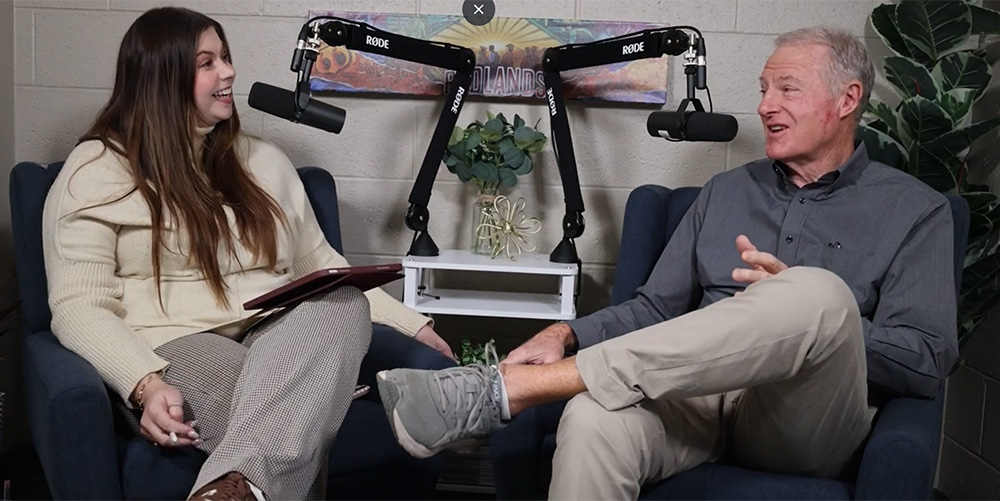
Watch this episode
Transcript
Sydney
Welcome back to Redlands or announces your podcast for college, career and everything
in between. We're excited to have James Tabor here with us today. Professor Tabor,
as a lot of you know him, and we're going to talk a little bit today about professors
who changed everything for us. And we're just so glad that you joined us on campus
today.
Mr. Tabor
Thank you for inviting me.
Sydney
You know that when Macey and I were talking about who should we have on campus who
really made an impact in a lot of students lives, I instantly was like, well, I know
who made a big impact in my life and in my educational journey. I know I transferred
over to USAO, I came back and I was like, I'm going to have a minor in history. Not
necessarily because I love history, but because I loved your class, and that I love
that you kind of made it come to life. And so I guess just starting there, when you
think about your path and how you got to teaching, How did you know it was the right
path for you?
Mr. Tabor
Well, honestly, I started out and said I was going to become a dentist, and I it took
one semester of, college chemistry and I changed my major. Well, I didn't even major
at the time, I this changed my direction. And, history was the class that I always
enjoyed. Growing up, my parents, on summer vacations they packed us, my brother and
I, in a car, and we go to some battlefield or some museum. And so it's already been
a part of my, my life, and, I enjoyed it. So that's how I got involved to going into
history here.
Sydney
My dad and my brother both really big history buffs, and they went to Mississippi
one summer for vacation, and I remember going to visit Vicksburg.
Mr. Tabor
Yes.
Sydney
And I remember talking to you about it and hitting all these things. And I remember
my dad saying, how did they ever find each other? You know, like this. Just so up
and down on the lake. And I always think that's what kind of brings it to life, because
people like you and people like him who were able to actually put that story there
with it. So do you have maybe something that you feel like students always remembered
about your class? Because I know that one of the things I've always thought is just
how engaging you were. And how did you make it feel alive for the students?
Mr. Tabor
That that's one of the hardest things to do, is to make a class the topic be relevant
to the students. So that's one thing I tried to do, is how is this topic? How is this
part of history, relevant to their lives and how it affects, affected not only then
that had, impact later? They, it's, it was challenging at times and it really was.
Sydney
Yeah. Well, especially all the way to today's age when everyone is so obsessed with
social media, and on our phone all the time. It also made it a little more difficult
to bring that to life.
Mr. Tabor
Luckily, they didn't have cell phones when I started.
Sydney
When you started right.
Mr. Tabor
Yeah. But, yeah, technology certainly changed things. That, you know, in the classroom
and the whole environment. And, I, as I say, the first time, I know I said this in
college, this about every class, the first class was, I know I'm have a rough audience
because hardly anybody will be a history major. And, you know, maybe 1 or 2. And,
I said my hope was not converge to history majors, but, you know, see, the history
does have an impact on their lives. They may not notice it and realize it right away,
but later on in life, they'll hopefully realize it.
Sydney
Yeah. I was always so impressed, and I think when I teach classes now, and I know
I talked with Professor Caro about this, will always talk about how you were such
an impact to us the way that you taught. And I think I try to take a lot of what you
did in the classroom and apply it when I'm teaching. But how, what would you say your
teaching style is? And would you say it evolved over the years?
Mr. Tabor
When I first started out, it was probably more mostly lecture. And, you know, as the
semesters and years went by, I tried to do less lecture and more try to get discussion
from a class. One class is it could be, you know, full discussion a lot of it depending
on how much they read coming into the class. And then, you know, you may have in the
next class same topic and that class, you know it's trying, like pulling teeth. It's
hard to, hard to get, you know, a discussion. But you know, last thing, if you've
ever seen the movie 'Ferris Bueller's Day Off'? Yeah. I didn't want to be that teacher
that was: "Anyone? And you are?" type of character. So, yeah, I'd say that probably
trying to add more to this much discussion and, and involving them in and then of
course, as I said before, making the subject relevant to.
Sydney
What did you find the most rewarding about being in the classroom?
Mr. Tabor
Or just being around students. Yeah, that was that was it. That that that's the that
was the other thing that attracted me to teaching in general was there was never a
dull moment. There really wasn't, you know, you know, I taught the same couple 2 or
3 classes every semester. It was still always fun because the students were new, and
that's, and the, the students were everything, really.
Sydney
Did you find a part of it challenging?
Mr. Tabor
Oh, yeah.
Sydney
The students?
Mr. Tabor
Yeah. Yeah. I, I wanted to challenge the students. I mean, I heard a lot of students
say: 'This class is so hard. You know, I don't want to take that.' But, You know,
I wanted it had to be challenging. That's the way life is. You know, you face challenges
in. And, you got to be able to adapt.
Mr. Tabor
Yeah. Absolutely. My dad always told us, you know, life doesn't owe you anything.
Yeah. And I remember when I first enrolled in your class, I did talk to someone, and
they're like. His class is so incredibly challenging. Like, you better watch out.
And it was a hard class, but it was enjoyable to me. Like, I was actually learning,
and I was in high school when I first did your class. Oh, no. And, and, you know,
the thing I remember about you in class is there's about four of you that I think
you all rode together at. But you, you also studied together. You, compare notes,
And you may not realize it then, but you were learning. Yeah, yeah. Just whether you
were driving to or from, the campus. We probably talk at some about the class that,
that interaction was important.
Sydney
Yeah. And I think it was probably the first time in, like, my life that I thought.
I'm actually learning something. High school, I think, for a lot of students, isn't
necessarily challenging a lot of the time. And for others, it can be. But, you know,
a lot of the curriculum that's there isn't necessarily things that you have to study
for. It's a lot of stuff that you maybe already know. And it it really was the first
time in my life that I thought, I, I'm applying myself to this and I've being challenged
by it, but it was so rewarding because I walked away being able to talk to someone
about a historical fact or figure that happened in history. Whereas, in the past it
was like, well, I made an A, but I don't really know what to tell you what I learned
there, and I, I really cherish that, and I still do. Speaking of historical events,
if you could add one historical event or topic to every student's required curriculum,
do you have one?
Mr. Tabor
Gosh, that, that is so, that's a tough one. You know, one one topic that I hardly
ever get and have had or hardly ever got enough time to to discuss, was the 60s. Yeah.
And I, I get close to the idea, get the bit through maybe the Kennedy administration,
but, Yeah, that, you know, post Kennedy and, Vietnam, talking about Vietnam War. You
know, the change in the [indistinguishable] counterculture and that, it's part of
the curriculum that just never got there, or rarely got there in a class. And so,
one time I thought about teaching history backwards, starting with, you know, like,
60s and then going back but, no I thought that'd be too confusing, not only for the
students, but for me too.
Sydney
Well, I remember and correct me if I'm wrong, but I really think one of the things
that you told us when we first started was you really didn't need us to know specific
dates. You just want to let us know what time periods and...
Mr. Tabor
World War 1 and World War 2...
Sydney
Yes. And so you may have succeeded in more than, you know, had you started with the
60s. Do you have a favorite memory from your time teaching?
Mr. Tabor
Oh, gosh. There. There's so many, you know, just, seeing the students when you're
in, in front of the classroom and you see a student, the light comes on and you can
see in, in their facial expression in their eyes that that was and that happened.
I won't say a lot because, no, no it did, but when that happens, that makes you realize,
you know, this is why I'm here.
Sydney
And it's very rewarding. I feel like when you're finally able to get something across.
Yeah. That's it. You know, when I was advising, that was kind of what I enjoyed about
it was seeing someone walk out of the room, with their head a little bit higher. You
know, not as discouraged as they came in. And so I, I'm sure that's very powerful
when you're up there in the front of.
Mr. Tabor
Yes, one of the things that I really think that was really important was to listen.
Yeah. To listen to your students, you know, whether there's an as a group, as an individual,
small groups just listen and, and, you know, try to, learn from what, what they have
to say.
Sydney
Well, that actually leads us into our next question. Despite maybe your classes being
a little more challenging, you really were one of the students favorite professors.
So what, How did you make that strong connection with them? Was there one thing that
you always focus on doing? I know you just...
Mr. Tabor
Yeah. Getting to know their names. And then listening. Yeah. That that was an, you
know, when I did engage with them and not necessarily tell them what was right or
wrong, but to have them make, you know, figure out to the right thing to do.
Sydney
Yeah. I remember in every one of your classes that I took, and it was a lot, that
we would write down our name and something about us and you would always remember.
And it was different than an icebreaker because I think during an icebreaker, it's
a little bit weird because you're like, my name is Sydney. And here's a weird fact
about me. But for you, you did it, like, let me know something about you that is important
to you that maybe is going to affect something in this class. And I feel like you
always took special detail of that.
Mr. Tabor
Well, thanks. We try to.
Sydney
Of course. Do you maybe have a moment that you remember something that a student once
said or did that really stuck with you while you were teaching? I knew you'd have
a good story for this.
Mr. Tabor
We were, this, the late Bill Gordon, who taught government and also had some history
classes. He was one of my best friends, and we put together a class on the night,
on the 60s. And, we and the students there is, is usually about 15, 20 students in
this one particular class of students, They were really engaging, a lot of fun. And
anyway, I just talked we were talking about, Woodstock. Yeah. And and, you know, the
impact it had and, and, and one of my students and she, she's a volleyball player,
and I won't say her name because it's it, but it's stuck. She goes, Woodstock, Woodstock,
Woodstock. Big woop. You know, I don't know why that struck me. It's so funny. But
yeah, she were big woop. And so, every once in a while I would, in a class, you know,
somebody would say something. Big woop. Yeah. That, Yeah, that one phrase just tore
me up.
Sydney
That's something I, I it's funny, the things that stick with you. I have a friend
who we were watching a basketball game one time, and she so seriously said, if we
want to win, we're going to have to put the ball in the hole and make it. And that
to this day, is something that my family and I will say, and if we want to win, here's
what we're going to have to do. What do you hope that your students would take away
beyond just the course material?
Mr. Tabor
Well, just to appreciation for for our country's history and, you know, one of the
things I know, I say every first class was I might get in trouble for this, but this
country's history is and is not perfect. Yeah. You know, it's made mistakes and and
oftentimes you they learn from these mistakes. And sometimes they we're still making
mistakes. And that has continued on for years, and started years and years ago. So
you know, have appreciation for, learn from its, its successes, but also learn from
its failures. That's the thing.
Sydney
I think that's a great lesson to take away because like you said, it's not perfect.
But that not the most important point of it.
Mr. Tabor
That and your and oftentimes in real life you learn more from your mistakes than your
successes. Yeah I know that sounds a little, contrite, but it's true. I really think
it is.
Sydney
And as I tell students all the time, like if you walk away from something and you
feel like it was a failure, you still learn something from it. Oh, yeah. And so what
more could you want? You know, I don't know. How do you want your students to remember
you specifically? And how do you hope they will remember you?
Mr. Tabor
As someone who, cared about them. Somebody that listened to them and, was somebody
that was fair.
Sydney
Well, as one of your past students. I can say I feel all of those things. I know that
some of my classmates that I shared your classes with feel the same way. So I think
you did a great job on that. Shifting gears just a little bit, remind me again, you're
retired in 2020, is that right? That was like your halfway retirement, I think actually.
Mr. Tabor
Yeah, I think that's when I retired. The years have gone by. Yeah I think that's about
right.
Sydney
Was it hard to step away or did it feel like it was time?
Mr. Tabor
It was time. Yeah. Yeah. I mean I still enjoyed and this is the thing. But you know,
I taught 44 years and about 30 here, at Redlands. I could probably in one hand the
days that I didn't want to come to work. I love teaching, I really did, but, you know,
2020, with the pandemic going on and I was I just felt, saw, felt it was time. Yeah.
And I haven't regretted it. I think I taught a Western Civ class online for 2 or 3
years, and then I thought, man, I'm ready.
Sydney
I'm going to really retire this time.
Mr. Tabor
Yeah. And it's, it's changed. You know what? I used to read. I mean, I've always read,
but, a lot, but, history books. Yeah. And, you know, the various topics and personalities
and stuff. Since I've retired, I mean, I read a lot. I've only read two books that
have dealt with history. I've been reading stuff that a lot of fun.
Sydney
Yeah, well, I think that's wonderful. Is there something that you miss the most about
teaching?
Mr. Tabor
Yeah. The just the engagement with the students, yeah, and, and the people here at
Redlands. I mean, I enjoyed talking to, and seeing fitting in, you know, the people
I worked with.
Sydney
Well, we did just walk the halls earlier, and it was like a local celebrity was with
me. Every person that we came across was like, oh, my gosh, Professor Tabor!
Mr. Tabor
I don't come back that often. So for me to go to the school and I got other things
I'm doing, which you know, so people ask me, well, what do you do in retirement? In
retirement? I don't know, I mean, I walked every morning for about four miles. I,
I read I, my wife, who's always got something for me to do and, and she really has
a list of stuff and, I think I got finished painting our dining room for the fifth
time, and my, Yeah, I that's a whole different deal. There's a lot in there.
Sydney
Oh, good. I I'm glad to hear that. I know that retirement. I feel like a lot of the
time goes 1 or 2 ways, or someone either really enjoys it or they really are itching
to go back to work. Is there something that you don't miss about teaching?
Mr. Tabor
Yeah, grading, and the and the hours, the hours for grading. And it's I always thought
is really important that if a student turns in an assignment that they get it back
quickly. And, not necessarily the next day or, but that, you know, certainly within
less than a week. Yeah. And so it meant a lot of, long hours of, of reading and correcting
and yeah. And the grading news.
Sydney
Well, especially with history because, you know, that's, you know, actual historical
facts, you have to get right.
Mr. Tabor
Well, then if it was important, have written, you know, whether there's essays or
short papers or stuff like that. And, sometimes going through those could be, a challenge.
Sydney
Yeah. You said you taught for 44 years. Do you feel like teaching still finds its
way into your life and probably other ways?
Mr. Tabor
Yeah, absolutely. I watch Jeopardy a lot, So I know that there, I'll see that answers
and and Yeah in conversations. Books I read you know, just. Yeah. Every day, every
day this comes in, you know, teaching has an impact on in some way or another. You
know.
Sydney
If you could go back at the beginning of those 44 years and give yourself one piece
of advice at the start of your career, what would it be?
Mr. Tabor
Do something that you love. And, how I'm lucky I found a job that, It wasn't really,
It wasn't a job. It was something I really enjoyed doing. Just about every day.
Sydney
I think it makes it a lot easier to get up out of bed in the morning. I'll be looking
forward to what you're going to. Oh, every day? Yeah. Was there maybe. Were there
qualities that you saw in students that made you excited or hopeful when you walked
into the classroom?
Mr. Tabor
Can't think of anything. That's okay. Any qualities that. Can't think, I can't think
of anything right off hand.
Sydney
That's okay. Yeah, yeah, I think, one of the things that always makes me excited is
like, when someone is engaged from the get go, I'm teaching Intro to Speech right
now, And so when I have students that are, you know, like, which doesn't ever happen,
that students are excited to give a speech. But when I have students, I'm like, okay,
yeah, I'll go. I am like, oh, okay. Yeah. You're like, let's do this thing. And so
I think probably for all of us as teachers, just that degree of like, you actually
care, even if it is just so...
Mr. Tabor
That's, that's yeah, I and I did care. It was is sincere. Yeah. There's there's, one
thing I didn't get a chance to do and we, we Bill board I think I mentioned we, we
toss some special interest classes or the 1930s, or 39 particular this 1960 classes
and, this shot, Professor [ShineKerr] had discussed and I had discussed before I left,
the possibility of doing a history and literature type, special topics class but then,
You know, I didn't get a chance to do that, but, yeah. And, thought you you can really,
teach a great, have a great history class just through literature. So. Yeah, I missed
out on that.
Sydney
Is there something that you wish more students knew while they are in school?
Mr. Tabor
I wish they knew how important education was, Period. In, in their lives. I'm not
just saying, you know, whether it's a trade or, you know, becoming a doctor or a lawyer
or whatever. Just always learning. Yeah. You try to learn something new every day.
Sydney
I know that a lot of us say in education. You know, knowledge is one thing that no
one can ever take from you. And I think that's something that I have really, really
honed in on as, as I get older. Is that the more I learn, the more I take in. And
is there just more things that people can't take from me. Or is the information that
I hold on to in the education that I have. And like you said, whether that's a trade,
whether it's college or whatever it might...
Mr. Tabor
Yeah, I don't know. That's one thing that since retiring I've tried to do is the,
you know, learn one thing every day. I haven't learned it yet today. But, you know,
my wife is, she decided when she retired about a year before I did, and, she's learning
French. Oh, wow. And, I haven't gone there. I feel like I'm learning just by listening
to her, listening to her. But, Yeah, doing something like that. Something that's maybe
takes you out of your comfort zone.
Sydney
Well and you all travel so much that that would benefit her well. And you'll also
benefit from her knowing it.
Mr. Tabor
Yeah. Well, we've we, we've been to France twice. Three times. And, you know, each
time she learns more and more and she's able to interact more with people and, yeah,
it's it it is said, well, even not only in France but in Belgium, where they take
a speak Flemish in their other half, speak French better.
Sydney
Those are really cool. Yeah, well, if you're okay with it, we're going to do a quick
speed round. You're welcome to answer as fast as you like. So okay. Number one, if
you could teach one class completely unrelated to your field, what would it be?
Mr. Tabor
a literature class.
Sydney
If you could time travel to witness any of that firsthand, which one?
Mr. Tabor
1517 Martin Luther nailing the, 95 theses, the criticism of the church of Wittenberg,
Germany. I would have loved to have seen that because that set off the Protestant
Reformation, which is why does it is quite the Revolution. Yeah, yeah.
Sydney
One historical figure You'd have coffee with?
Mr. Tabor
I, Barack Obama, I think, I'd love to talk with him. We we have a lot of interest,
you know, in sports and, you know, things outside of politics and, Yeah, I think it.
And it's him and his wife are both on my Sit down and have a, coffee or drink or whatever,
Cover for them.
Sydney
Best historical movie?
Mr. Tabor
Band of Brothers. Yeah.
Sydney
Is there a worst historical?
Mr. Tabor
Pearl Harbor.
Sydney
I like that that one was way faster than the rest of them.
Mr. Tabor
Pearl Harbor. Yeah. Best thing about that movie was Kate Beckinsale. She, And but,
yeah, so many historical inaccuracies in there.
Sydney
Favorite class you've ever taught?
Mr. Tabor
1960s class. Yeah.
Sydney
A piece of advice you found yourself giving over and over.
Mr. Tabor
Be patient and listen.
Sydney
One thing you wanted every student to learn beyond the curriculum.
Mr. Tabor
How just really how important it, history was. And, you know, one of the things that
I would have a student that would, run into a student that was in my class and they
would come back or they, you know, a couple semesters later, they were taking another
class of something and they would stop by, says, Mister T, I saw this on TV, and I
remember this talking about in class. And, so that was always, that was a bit of a
boost. Yeah. Yeah.
Sydney
One word you students would used to describe to you.
Mr. Tabor
Challenging.
Sydney
I always thought you were so funny. Oh, really? Yeah. Oh, I love to hear.
Mr. Tabor
I said, another reason, I kind of felt it was time to retire, I would use references
in class that were very pertinent when I started teaching that, And as the years went
by, I'd use this reference and they'd go: the heck are you talking about? So yeah.
Sydney
I remember I would go home, because you would tell stories about Walmart being like
the evil Empire. Yeah. And I would go home and I'd be like, dad, he feels the same
way, that you do.
Mr. Tabor
Still have been set foot in Walmart. It's been 30 something years. Yeah. It's, you
know, been a long time seem to be doing well without my business, so.
Sydney
I think there's reminding, most rewarding teaching moment.
Mr. Tabor
Oh, man, Probably. And I know this may sound, our former president, Jack Bryant, always
said, I agree with, wholeheartedly, watching those students get that diploma, you
know, their associate's degree, that was whether they are my student or her and other
students just watched them get that. That was all. Is that was or was a reward.
Sydney
Yeah for sure. And I think getting to see someone like you said, even if they weren't
in your classroom, but knowing that the work that they put in over the years, they
achieved that for sure.
Mr. Tabor
That these things change.
Sydney
That they do. You'll have to check out the bathrooms. They got new bathrooms, they've
been renovated. They're really nice.
Mr. Tabor
Okay. Old man.
Sydney
Yeah, well, I thank you again for coming in, and I'm just really excited. And I'm
excited for our students and our listeners and our faculty to listen to this and to
get to hear a little bit about your journey and just the things that you've been doing
and the things that you did earlier in the classroom.
Mr. Tabor
I'll say, they do and say thank you. And it's it's, the you're an example of another,
reason why I enjoy my teaching is to see students like you come back here at Redlands
and, make this a greak institution. We've been, you know, and, you know, keeping in
touch with students years afterwards. It's, Yes, it's pretty cool.
Sydney
Yeah, it has been. I always talk about I tell people all the time, like, I always
use Professor Taber on my reference to the point that he was like, you don't have
to ask me. Just throw me on there. And that relationship that I've made with you has
helped me so much with my life that's been so important to me. And so I was just really
excited that I got to do this with you and, and help people learn a little bit more
about you that maybe didn't get to have you in the classroom.
Mr. Tabor
Thank you.
Sydney
And thank you listeners. Make sure that you're tuning into Spotify, Apple Music, and
everywhere that you get your podcast, and we'll see you next time. Thanks, guys.