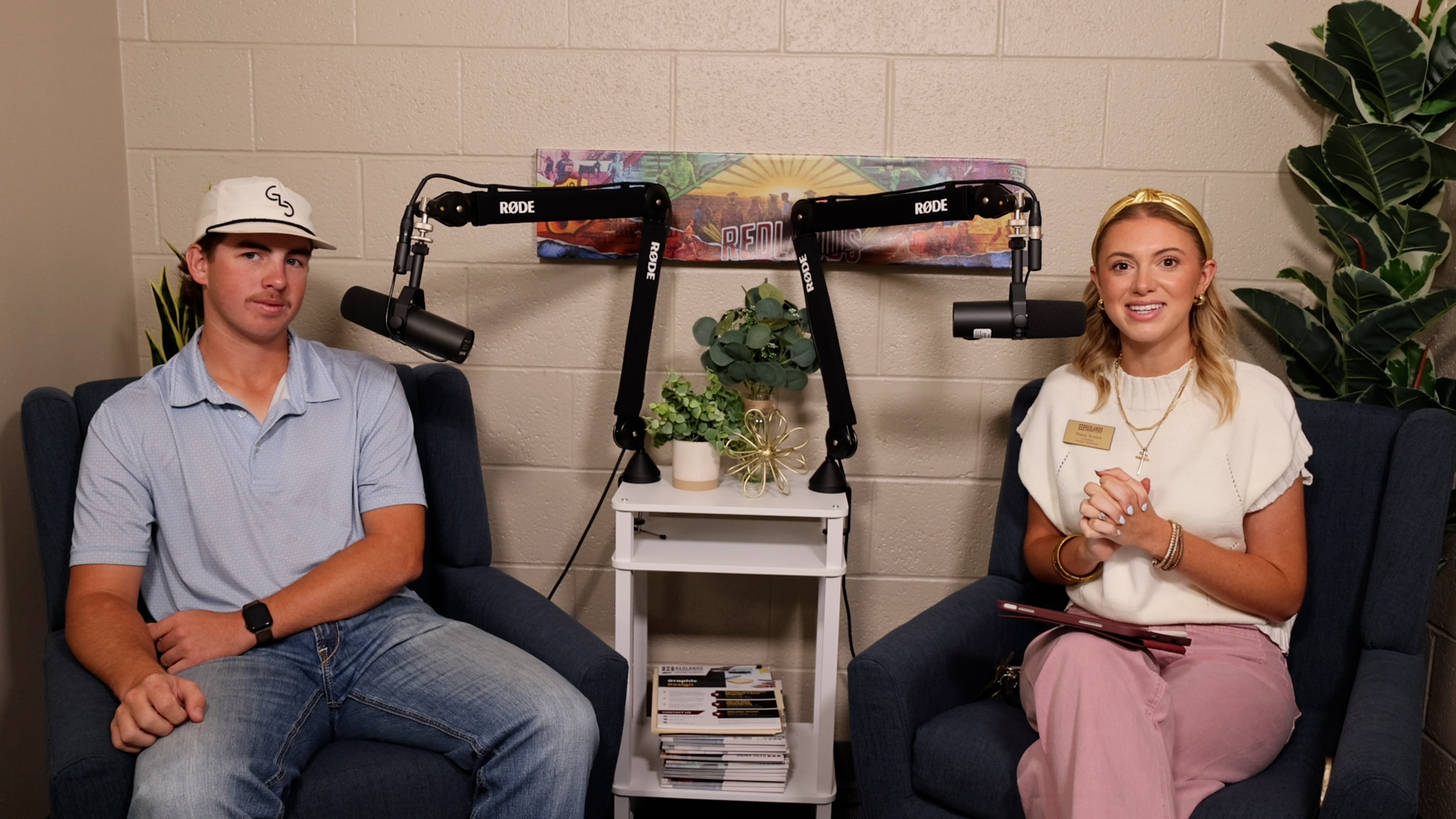
Watch this episode
Transcript
Macey
Hey, everyone. Welcome back to The Redlands Rundown, your official podcast of Redlands
Community College, where we're here to help you find success in the classroom, in
your career, and with everything in between. With me today, I have Grady Lesperance,
and I'm really excited to have him. We've been working through a lot of schedules.
You're a very busy person, so I'm excited to have you on the podcast today.
Grady
Thank you. Happy to be here.
Macey
So before we get started and I dive into all my questions, I just want you to tell
our listeners a little bit about you, your background, where you're from, all the
fun stuff like that.
Grady
So my name is Grady. This is my third year here at Redlands. I play baseball here,
and I'm a ag business major. I plan to go to Oklahoma State afterwards and get a degree
in turfgrass management.
Macey
Cool. And your hometown?
Grady
I'm from here in El Reno, Oklahoma.
Macey
Yeah. So he's a hometown-er, going to school in his backyard. [It's very true.] Yep.
So we'll-we'll dive into that just a little bit more. And you've grown up in El Reno
all of your life? [Yes, whole life.] Okay, cool. Are your parents from El Reno as
well? [Yes.] Okay.
Grady
Both graduated from the same high school, one year part. They've been there whole
lives as well.
Macey
That's awesome. That's super cool. Okay, so, one of the things that I want to talk
about that we've kind of hinted at already is the fact that you chose to stay in your
hometown for college. And I think that, typically, when people think about going to
school, when they graduate high school, and I was guilty of this, I was excited to
get out of my hometown. And so I want to dive into that just a little bit more, because
it's something that we and administration has talked about: How do we kind of overcome
that stigma that, you know, we're the college in the backyard or in the hometown that
people don't necessarily want to go to? So I want you to talk about that, like, how
did you make the decision to, to stay at home or not necessarily stay at home, but
stay in your hometown and go to school at Redlands.
Grady
Yeah. So leading up to my senior year, I really had no clue what I wanted to do or
where I wanted to go for college or what degree I wanted to major. And just through
communicating with some of the professors here and the baseball coaches, I decided
to-I'd want to play here. And, so I really had no clue what my major would be. I just
decided to go general ag in the beginning, and then it ended up migrating the ag business.
Macey
Okay, gotcha. So didn't really have a plan, but kind of through some connections...
[Exactly.] And I think that's a good I'm glad that you say that, because I feel like
there is a pressure, especially as you get to like your last few years of high school,
to have it all figured out: to know what you're going to do, to know what you're going
to major in, where you're going to go. And so, that pressure can feel really overwhelming.
Did you feel like did you have that pressure kind of looming on you?
Grady
Yeah, a little bit. Just because everyone else, all my friends, are going to all these
bigger schools far away, and I'm choosing to stay in town.
Macey
Yeah, yeah, I get that. So how did you navigate those feelings, like that feeling
of pressure or those conversations with your friends?
Grady
I think it was more the fact of just everybody's accepting where they're going in
life, what they're wanting to do. Like, for me, I knew that I wanted to play baseball
here, while others are going off to get their degree. While I still get the chance
to play baseball, I'm also starting that the next step for my education here.
Macey
Yeah. So you made the decision to stay. You've been here, now you're going on your
third year. What do you feel like? Do you do you think that there have been any opportunities
or things that you've been able to do that you may not have been able to, you know,
if you had went somewhere else?
Grady
Definitely the baseball side of things. That was kind of an opportunity that was kind
of just thrown in my lap. They said that we'd be happy to have you. And so I was able
to walk on and end up earning a spot on the team. But overall opportunities, I'd like
with the local FCA and the BC and things like that. Like most colleges have that,
but with this campus being so small, it makes it more personal just to get to know
everybody through classes, teams, just living on campus, things like that.
Macey
Yeah, it's really easy to get involved. And also a lot of the people that are involved
in those clubs and the extracurriculars, they're really welcoming, like they're excited
to have students to, to join those things. I also want you to touch on-do you think
that being close to home and your family like that also helped you to grow in your
last few years?
Grady
Absolutely. Just because, like, living on campus, all these other, all my friends
are moving away-hours away from home and just into the unknown. While I get to live
five minutes down the road from my family, so I have help if needed. And free laundry
and free meals, obviously. [Yeah, that's big bonus.] It's nice to be able to live
on my own and kind of just explore that and just kind of, like, figure out how, like,
I function, just kind of on my own. But it's also nice to have family and friends
in the back pocket right down the road.
Macey
Yeah, absolutely. So you're staying in the dorms on campus? [Yeah.] So that's nice.
You're getting to kind of venture out but also have that support system [Absolutely.]
right down the road when you need that. So that's cool. Okay. So a question I want
to ask you what would you say to a high school senior, that thinks they have to leave
their hometown to be successful?
Grady
I would say that that's not true just because, like, it's one thing to go be successful,
but is it-is that where you want to be just because it's like, if they have to, you
have to think about the financial side of things, what degrees they offer, how big
the classes are, things like that. Like, here at Redlands, our class sizes are fairly
small compared to most bigger colleges. So you're actually getting to connect with
your professors, not just to be a number. But also like just being on campus. Like,
you make more connections than you ever thought you would. I mean, even though it's
in your backyard, doesn't mean they like-I know a few people from high school here,
but I've met people from all around the world.
Macey
Yeah, absolutely. We, we have a really diverse group of students here that come literally
from all over the place. When you say all across the world, that is not an exaggeration.
[Not at all.] Yeah. I think that makes it really special to have the small family
like feeling, but to have so much diversity here also. Okay, so I want to transition
now into your baseball journey and talk about that a little bit more. So you came
here, obviously. And I always tell my livestock judgers, your first job is to be a
student. But also, you know, another priority of yours was being on the baseball team.
So I want you to talk about your baseball journey. When did you start playing? Give
us a little background about that.
Grady
So I've been playing baseball my whole life, since I was four years old. And just
kind of-I tried all sports and baseball was just the one that really stuck with me.
And through high school, like, I was hesitant on if I wanted to go play in college
and my senior year I was able to-the head coach at the time said, like, you have a
spot here, if you want to try it out. And just due to the financial side of things
and the classes I was wanting to take, it worked out for me to be able to stay here
on campus and play baseball. I did end up tearing my labral in my arm, which is the
result of why I'm here: third year. Because they invited me back for that third year
of baseball. So I did have to add more classes, as you can imagine. But, I've been
playing baseball my whole life and just fell in love with it from the beginning.
Macey
Yeah. That's awesome. So, then you decided that you wanted to play collegiately, take
advantage of that opportunity. What was your role when you first got here? And then
what is your role look like now?
Grady
So at the beginning, it was just really trying to earn a spot, which I am still trying
to earn spot now, but I've definitely, become more accustomed to the ins and outs
of every day what practices and games will look like, and just what my role overall
as a pitcher would be too, whether it's coming out of the bullpen or, just waiting
for my next turn to throw whether, whatever it is. They definitely have a role for
it.
Macey
Cool. So something that I talk with my livestock judgers is, you know, we do a lot
of practice together as a team, with the coaches. But also, you know, if you want
to get to where you want to be, there's a lot of work that has to go in [Absolutely.]
outside of practice and kind of behind the scenes. Can you tell some of our listeners
about some of the work that you've done behind the scenes.
Grady
So, we all have our we have our everyday practices and things like that. But they
do leave the-our indoor facility unlocked until around 9, 9:30 every night. And so
we have guys going in and out through all times of the day, hitting, lifting, throwing,
whatever they need to do to excel at their position, or whatever work they need, whatever
they're struggling with.
Macey
Okay, cool. And then will you tell us a little bit about balancing-You know, you're
so involved in a lot of extra things-balancing your extracurriculars, your class,
your classes, being on the team. How do you balance all of that?
Grady
It's, it's definitely a struggle at first you have to try and find that balance, and
so you don't feel like you're juggling everything. You definitely have to find the
right time to associate with each thing. Like with the teammates and friends, like
I live with all those guys. And so it's, like fun to build those relationships. But
then you also have to know when to step away from that and make sure that your priorities,
priorities are straight with school and class work and all the things. And now we
do all do homework a lot together, whether that's watching TV, football, whatever
it is, but we're all trying to stay on top of our grades.
Macey
Yeah that's cool. I like that you guys kind of are a support system for each other
as well. That really-and having someone else that helps keep your teammates like accountable
and helping each other. That's something that I think a lot of students would really
appreciate. And I think a lot of students can relate to that, even if it's not being
on necessarily an athletic team, but having their groups of people or whatever clubs
they're in, just a circle of people around them that helps to keep them accountable
and keep them focused when they need to, that's really helpful. So talk to me a little
bit about what are some things that you feel like you've gotten out of being on the
baseball team outside of just being able to play and travel. [Right] What are some
things that you feel like you've been able to learn and grow from being on the team?
Grady
Definitely just learning different cultures. My first year here, we had a guy from
Venezuela. We had a guy from Colombia. Then last year we added two guys from Australia.
And so learning the different cultures and things that they do and, different slang
words that they use, like things that are uncommon here. That's been interesting.
But I think overall, just like learning the ins and outs of like everyday life with
different people and how it works. Like living not with your family. It's definitely
a much different than, just waking up and having your own chores to do. Like, we'd
have chores in our own dorm rooms as well, but it's more different than your mom telling
you to wash the dishes. It's [Right.] It's an accountability thing.
Macey
Yeah, absolutely. Yeah I think that's really cool. And I remember like when I first
came to school at Redlands, there's a bit of like shock value at first when you move
out of home and you're having to do, you know, things on your own for the first few
months. And so, yeah, I'm so glad that you had a great like, you've had a great support
system and teammates to lean on during that kind of transition, even though your family
is right down the road.
Grady
Absolutely. That's what makes it easy as well, is because I'm not moving in with a
bunch of, people I don't know, [Right.] which I am, but through baseball, like we
all build that bond that we can kind of get to know each other a little bit on a deeper
level than just, okay, like just living across the living room from me.
Macey
Yeah. Yeah, exactly. So how do you feel like you're experience here at Redlands for
the last few years and being on the baseball team? How has that prepared you for when
it comes time to transfer?
Grady
I think personally it's just a matter of, like, figuring out, like where you are,
like be where your feet are, but also you have to be prepared to go to the next place.
It's not like focusing on where you're at now, but focusing on the future and what
you need to do to prepare for that. And so like the biggest thing for us as, like
for me as a baseball player is that I have to make sure that my body is in shape for
baseball but I also have to make sure my grades are on point for-so I can stay eligible
for baseball, but also so I can keep scholarship money and just an overall good GPA
and good grades.
Macey
And yeah, I like what you said about like being where your feet are, but also being
ready to move on to the next thing. [Right.] I think especially as students get close
to graduation and they're nearing their final semester, I start to see it where students
are so focused on the next thing, they're forgetting where they're at a little bit.
And then I've seen a lot of students after they transfer, they miss Redlands so much.
And so I'm glad that you say that, you know, be where your feet are and really make
the most of every day that you have when you're, you know, when you're at Redlands
or when you're at your senior college, wherever you're going afterwards or wherever
you are in life. I think that's something that's so easy to get so caught up in looking
forward, where you miss where you're at right now. So, I'm so glad that you say that
because, you know, your first two years in school, especially at Redlands, those are
special times. [Oh yeah.] I think that's a great piece of advice, like, you know,
be mindful and be setting yourself up for success in the future, but enjoy where you're
at right now. [Absolutely.] Yeah. Very cool. Okay. So as we're kind of getting where
we're wrapping things up a little bit, I want you to expand a little bit more on what
your team really means to you. You've talked about it a little bit, but tell us a
little bit more about what your team, being on the team, what does that mean to you?
Grady
It's it means a lot to me just because, like, I think it helps with the fact that
I'm not living at home. It's like, for all of us, really. It's because, like, we all
have someone to turn to whenever, like, things get tough, but, like, whenever things
get bored around here, like, someone's always next or someone's always doing something.
Whether that's just playing cards or watching football, even doing homework. Like
we're all together, all the time. And that just means a lot. Just because, like, you
get to know and build these, you know, these people, but build those connections.
These are people you you'll know for life and connections you'll have for forever.
Macey
Yeah. That's awesome. So as we're kind of wrapping up, is there any pieces of advice,
final things that you would leave with any of our listeners that are seniors, trying
to navigate decisions on where to go to school, whether or not to be on that competitive
team. What would you share with our listeners?
Grady
I'd definitely say, don't be scared to stay where you're from, but also don't be scared
to venture out and go. So the next whatever is next for you. I'd say be involved wherever
you go. But don't feel so stressed out to your overwhelming your self from not building
those relationships and not getting your grades taken care of. Definitely, keep your
priorities in line and you just have to learn how to juggle it all, really.
Macey
Yeah, yeah, I think that, you know, your point of saying don't be scared to stay,
but also don't be scared to go. [Right.] Because you and I both are-you're going to
be a graduate of Redlands. I'm a graduate of Redlands, but I moved 7.5 hours from
home, you know, and you're seven minutes from your house. But both of us have experienced
what Redlands could do for somebody. And I think, you know, I would encourage students
to go look at all of the places they're thinking about going. I think going and experiencing
that and doing a tour and talking with people on the campus and kind of going through
the community for a day, that kind of gives you a feeling of, is this a good fit for
me? [Right.] And just go and see what you think and whatever feels the best to you,
you know, that's that's probably the place where you need to go. [Yeah.] So I'm really
glad that you say that. Just, just go Where is the best place for you. The best fit.
Don't be scared to stay home, but don't be scared to venture out. That's a really
good piece of advice. Cool. Okay, well, thank you so much for joining us, Grady. I'm
really grateful that we were able to have you on the podcast. You are such a star
for Redlands, not only as a competitive team and as a student here, but also like
so much that you do in the community and your involvement. So we're really proud that
you have chosen Redlands for the last few years and really excited to see where you
go in the future.
Grady
Well, thank you very much.
Macey
Yeah. Cool. Well, thank you guys for joining us this time. We will see you next time
on the Redlands Rundown. Bye.